The Hidden Way Your Car Seat Is Destroying Your Gains

Photo: athletic person adjusting car seat ergonomics proper driving posture, via ahrefs.com
You're putting in the work at the gym. Your programming is dialed. Your nutrition is on point. But something keeps nagging — tightness in the hip flexors that won't quit, a shoulder that pulls weird on pressing days, lower back stiffness that shows up every single Monday morning.
Before you blame your mattress or your training volume, take a hard look at where you spend a significant chunk of your waking hours: your car seat. For the average American commuter, that's roughly 300 hours a year behind the wheel. That's 300 hours of either reinforcing good movement patterns — or systematically wrecking them.
Let's break down exactly what's happening, and how to fix it.
The Biomechanics Problem Nobody Talks About
Sitting in a car isn't passive. Your body is constantly making micro-adjustments to maintain position, manage vibration, and respond to steering inputs. The problem is that most factory seat setups push drivers into a posture that's actively antagonistic to athletic performance.
Here's the breakdown of what typically goes wrong:
Hip flexor shortening — When your seat is too low or your knees are higher than your hips, your psoas and iliacus lock into a shortened position. Over time, this creates anterior pelvic tilt, which flattens your lumbar curve, shifts load onto your lumbar discs, and limits your hip extension capacity — which is critical for squats, deadlifts, sprinting, and virtually every athletic movement pattern.
Thoracic flexion — A seat back that's too reclined or headrest that's too far forward pushes your head into forward flexion and rounds your thoracic spine. The result? Compressed pecs, inhibited lower traps, and a shoulder girdle that's primed for impingement — not overhead pressing.
Asymmetrical loading — Most drivers rest their left arm on the door, right arm on the wheel or center console. This creates a lateral imbalance in the obliques, lats, and even the hip stabilizers. Multiply that by hundreds of hours and you've got a structural asymmetry that shows up as lateral movement dysfunction in the gym.
Grip tension — Gripping the steering wheel with consistent tension engages the forearm flexors and creates chronic tightness that limits wrist mobility. For lifters, this directly affects barbell positioning in front squats and overhead movements.
The 6 Adjustments That Change Everything
1. Seat Height
Your hips should be at or slightly above knee level. If your knees are higher than your hip crease, raise the seat. Most power seats have a height adjustment lever on the lower outboard side — use it. This single change reduces hip flexor compression more than almost any other adjustment.
2. Seat Distance From the Pedals
Your knee should have a slight bend — roughly 20 to 30 degrees — when the pedal is fully depressed. A fully extended leg means you're reaching, which rotates the pelvis and loads the lower back. Too close and you're cramped, which compresses the hip flexors even further.
3. Seatback Angle
Forget the laid-back cruiser lean. A slight recline of 100 to 110 degrees (just past vertical) maintains your lumbar curve, reduces disc pressure, and keeps your thoracic spine in a more neutral position. If you're driving at 120 degrees or more, your head is already forward of your shoulders — and your traps are working overtime to compensate.
4. Lumbar Support
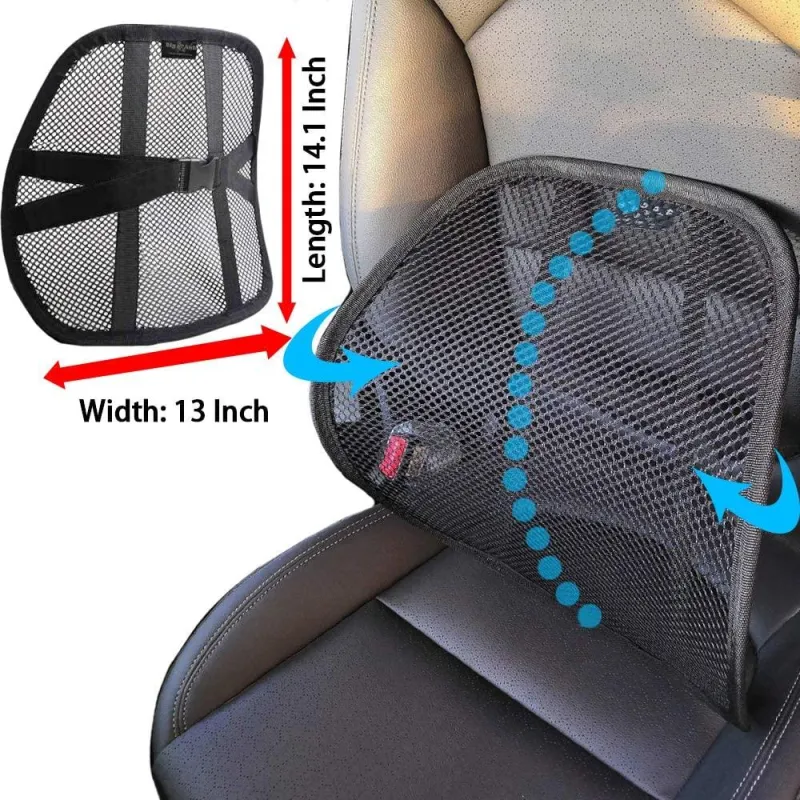
This is the most overlooked adjustment on vehicles that have it. Dial the lumbar support until you feel gentle contact with your lower back without it pushing you into an exaggerated arch. If your car doesn't have adjustable lumbar, a firm aftermarket lumbar cushion — brands like Everlasting Comfort and Xtreme Comforts make solid options — can replicate the effect for under $40.
5. Headrest Position
The top of the headrest should align with the top of your skull, and the pad should sit within two inches of the back of your head. A headrest that's too low forces you to extend your neck to see the road clearly — a pattern that feeds directly into upper trap overactivation and cervical joint stress.
6. Steering Wheel Position
If your car has tilt and telescoping wheel adjustment, bring the wheel close enough that your wrists rest on the top of the wheel with your elbows slightly bent. This keeps your shoulders down and back rather than rounded forward. Think of it as maintaining a "proud chest" position — the same cue you'd use on a bench press setup.
Product Upgrades Worth Considering
For drivers who spend serious time behind the wheel, stock seats often just don't cut it ergonomically. A few aftermarket upgrades can make a measurable difference:
- Seat cushion inserts — Memory foam or orthopedic wedge cushions (try ComfiLife or Everlasting Comfort) tilt your pelvis to a more neutral position and redistribute pressure off the ischial tuberosities
- Lumbar rolls — A firm cylindrical support placed at the lumbar curve works better than many built-in lumbar systems
- Steering wheel grips — Thicker grip wraps reduce the tension needed to hold the wheel, decreasing forearm fatigue and improving wrist neutrality
- Aftermarket sport seats — For serious athletes who want real ergonomic improvement, brands like Recaro and Sparco offer seats designed with lateral support and lumbar positioning that far exceeds most OEM options
The Self-Audit Checklist
Run through this before your next drive:
- Are your hips at or above knee level?
- Is there a slight bend in your knee at full pedal depression?
- Is your seatback between 100–110 degrees of recline?
- Does your lower back make contact with the seat or lumbar support without forcing an arch?
- Is your headrest aligned with the top of your head?
- Can you rest your wrists on the top of the steering wheel with elbows slightly bent?
- Are both arms making roughly equal contact with support surfaces?
- Is your chin level — not tucked or extended — when looking at the road?
If you checked fewer than five of those boxes, your driving posture is actively working against your training.
The Bottom Line
The gym is where you build fitness. Your car is where you either protect it or erode it. With the average American spending nearly an hour a day driving, the cumulative postural load of a poorly configured seat is significant enough to create real, measurable muscular dysfunction.
Fix your setup, and you're not just more comfortable on the commute — you're walking into every workout with a more balanced, functional body that's actually ready to perform. That's the AutoFit mindset: every environment you're in is an opportunity to optimize. Your car seat is no different.